BUYER'S MANUFACTURING GUIDE
How to choose a custom pajama manufacturer.
A practical framework for turning a sleepwear idea into a repeatable, retail-ready product program.
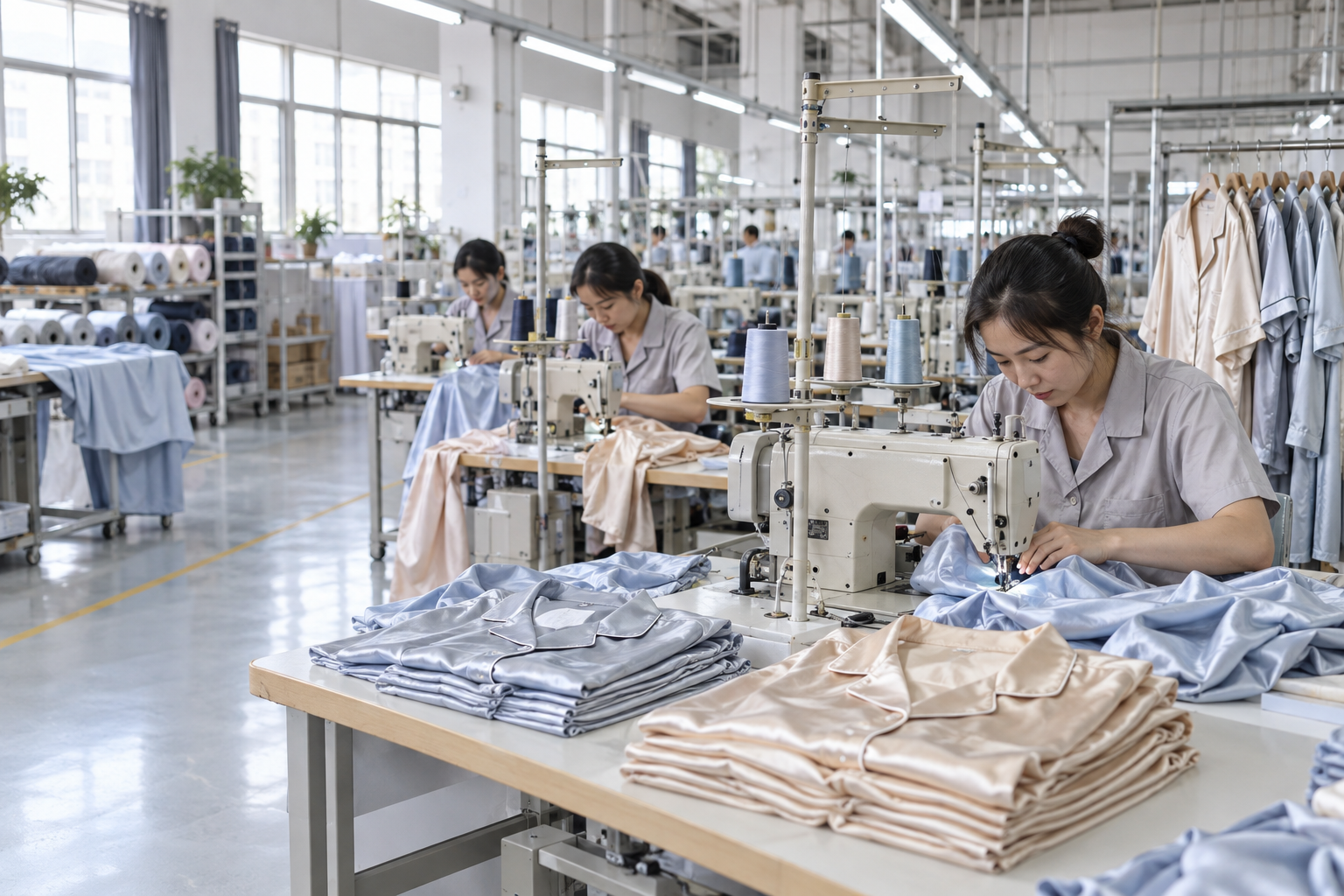
Choosing a custom pajama manufacturer is not simply a price comparison. The factory you select influences the accuracy of your samples, the consistency of the finished garment, the clarity of your delivery plan and, ultimately, how your customers experience your collection. A good supplier makes the work easier to see and easier to manage.
For a private-label sleepwear program, the practical questions start well before bulk production. Can the factory translate your reference into a complete specification? Does it understand the behavior of satin, cotton poplin, modal jersey or brushed knit? Can its team document measurements, trims, labels and packaging in a way that protects your decisions later?
This checklist is written for brand teams sourcing custom pajama sets, nightdresses, robes and gifting programs. It gives you a structured way to compare factories without relying on vague promises or a sample photo alone.
01
Start with a product brief that a factory can actually use.
Before asking for a quotation, describe the product in enough detail that two factories would be pricing the same thing. A helpful brief does not need to be a finished tech pack, but it should state the silhouette, intended customer, target market, estimated quantities and the level of finish you expect. Reference images are useful when paired with notes about what must stay and what is only inspiration.
For sleepwear, specify the fabric direction early. A satin shirt-and-trouser set, for example, involves decisions about fiber content, weight, sheen, opacity, seam behavior and piping. A modal jersey program has different priorities: recovery, pilling resistance, neckline stability and wash performance. These choices influence the pattern, construction sequence and production cost, so a factory should ask the right follow-up questions rather than filling gaps with assumptions.
What to include before sampling
- Target fabric, hand feel and color direction, with swatches where possible.
- Garment category, fit preference, size range and intended customer market.
- Construction details such as piping, lace, elastic, embroidery, buttons, pockets and labels.
- Packaging expectations, whether it is a folded retail set, drawstring pouch or gift box.
- Expected order quantity and target delivery window.
The more clearly the first sample is framed, the more useful the factory's response becomes. It should identify open points, propose practical alternatives where needed and explain what must be confirmed before bulk. That is a stronger signal than an immediate but unexplained price.
02
Check whether the development team understands sleepwear construction.
Development capability is where a promising product idea becomes a reliable specification. Ask who will review your brief, who makes or checks the pattern, and how fit comments are carried from one sample round to the next. You should be able to see a documented progression: initial sample, measurements, comments, revised pattern and pre-production confirmation.
Specialized sleepwear knowledge matters because comfort is built into small decisions. Collar shape, placket width, sleeve balance, elastic tension, pocket placement, French seams and piping corners all change the way a garment wears and launders. The right factory will not overstate what it can do; it will explain which details are feasible for the chosen material and quantity, and where a different construction would create a more stable result.
Look for a manufacturer that can support fabric and trim sourcing alongside pattern work. Sourcing is not only about finding a color. It is about confirming repeatability, lead time, substitution control and whether an alternative material will change the agreed hand feel. For complex programs, a sample room close to the production team helps avoid a handover gap between approved sample and bulk line.
When comparing partners, ask to walk through the actual sample approval process. A clear explanation of pattern revision, fabric approval and trim sign-off tells you more than a gallery of finished garments.
03
Review quality control as a sequence, not a final checkpoint.
A final inspection is important, but it cannot repair decisions that were unclear at the start of production. For that reason, strong quality control begins with a pre-production review. Before the line starts, the factory should confirm approved fabric, color, measurements, trims, labeling, folding method and packaging requirement. This gives everyone one written source of truth.
During production, in-line checks help catch issues when there is still time to correct them. The inspection focus should match the product: sewing quality and seam allowance, measurement tolerances, shade consistency, button security, printing placement, label accuracy and packing counts. For a satin set, inspect snags and pressure marks under normal light. For cotton poplin, check alignment, shrinkage allowance and pressing. For jersey, look at seam recovery and twisting after wash testing.
Ask how findings are recorded and who has authority to stop or correct a problem. The answer should be concrete. A vague statement that “all goods are checked” is not enough for a buying decision. Your team should know what will be checked, at what point and how exceptions are communicated.
Our quality process page outlines the three moments that are most useful to align before bulk: pre-production review, in-line monitoring and final shipment inspection. Use the same structure when speaking with any manufacturer.
04
Assess communication, timing and ownership before placing a bulk order.
Good communication is operational, not performative. You need a named contact who can summarize decisions, identify missing information and connect the sales, development, sourcing and quality teams. In the early stages, evaluate response quality rather than response speed alone. A reply that restates your request, flags risks and provides a next step is more useful than a quick generic quotation.
Request a practical critical path that separates sampling, material confirmation, bulk production, inspection and packing. Every calendar will change, but a transparent plan makes changes visible early. It also helps you make decisions at the right time: approving lab dips before fabric production, confirming labels before packing and reviewing carton marks before shipment.
For brands managing a launch date, establish how often the factory will update you and what will trigger an escalation. At minimum, request updates when samples are ready, fabrics are confirmed, production begins, inspection is scheduled and goods are ready for dispatch. This keeps your internal marketing, warehousing and retail teams aligned with the manufacturing reality.
Send your product brief ↗05
Confirm export readiness and protect the final handover.
The last stage is often overlooked because the garment is already finished. Yet carton dimensions, assortment ratios, barcode placement, polybag warnings, labeling and shipping marks can affect a retailer's receiving process. Confirm who checks these details and how the final packing instruction is controlled.
A factory serving international buyers should be able to discuss shipment inspection, carton packing, document preparation and handover to your nominated forwarder. It should also be open about what information it needs from you: destination requirements, carton marks, shipping method and timing for booking. If you work with testing or certification documents, provide the current requirements early and make sure the document holder, applicable material and production lot are clear.
The best supplier relationship is not based on finding a flawless first order. It is based on creating a repeatable way of working. When development notes, production checks and packing requirements are documented well, the next seasonal program becomes faster and easier to control.
READY TO START?
Bring us your brief. We will help turn it into a production plan.
Share your reference, target quantity and launch timing. Our Shenzhen team can advise on material direction, sampling steps and the checks needed before bulk production.
Request a Project Review ↗